

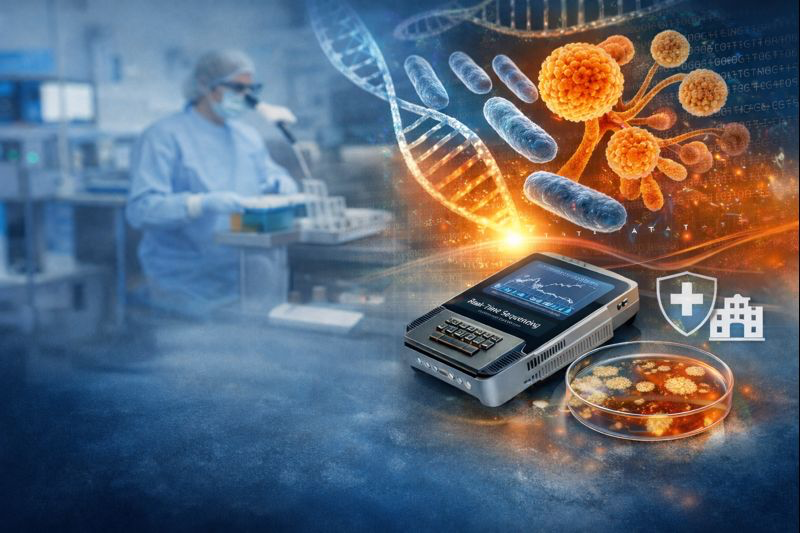
Dr. Tracy Hazen, Assistant Professor and faculty member in the Center for Advanced Microbiome Research and Innovation (CAMRI) at the Institute for Genome Sciences (IGS), is part of a multidisciplinary collaborative team that has been awarded a UMMC & UMB Innovation Challenge award to develop a next-generation diagnostic assay for infectious diseases.
Infections of unknown etiology remain a major challenge in clinical care, often leading to prolonged, costly, slow, and frequently inconclusive diagnostic workups. Current out-of-house reflex testing can take more than two weeks and cost upwards of $1,500 per sample, delays that limit clinicians’ ability to make timely, targeted treatment decisions. This Innovation Challenge project aims to dramatically shorten that timeline while expanding the diagnostic information available to clinicians.
The awarded project will develop and validate a rapid sequencing-based clinical assay capable of simultaneously detecting bacterial and fungal pathogens and clinically relevant antimicrobial resistance genes (ARGs). By combining targeted amplification of the bacterial 16S rRNA gene, the fungal ITS region, and resistance markers with real-time DNA sequencing, the assay is designed to deliver comprehensive results within 24-48 hours at a fraction of the cost of current approaches. Importantly, the assay will also provide insight into antimicrobial resistance mechanisms that are not routinely captured by existing commercial diagnostics.
A central innovation of the project is the adaptation of long-read sequencing technologies for low-biomass clinical and environmental samples, which have historically posed technical challenges for rapid diagnostics. Leveraging recent advances in nanopore sequencing and novel assay design, the team aims to overcome limitations in DNA yield and sequencing efficiency that have constrained prior approaches. In addition to improving patient diagnostics, the assay has the potential to support hospital infection prevention and control efforts through enhanced surveillance of pathogens and resistance genes in environmental samples.
The collaborative team includes experts from the University of Maryland Medical Center (UMMC) Microbiology Laboratory, Infectious Disease and Infection Prevention programs, Maryland Genomics, and CAMRI. Dr. Hazen’s participation reflects CAMRI’s growing role in translating microbiome and genomic science into clinically actionable tools.
This Innovation Challenge award highlights the strength of cross-institutional collaboration between UMMC and UMB and underscores CAMRI’s mission to advance innovative, clinically relevant solutions that improve patient care, strengthen infection control, and reduce healthcare costs.