

A recent visit to the University of Costa Rica (UCR) brought together scientists from Costa Rica and the University of Maryland School of Medicine (UMSOM) to explore new research directions focused on aging, longevity, women’s health, and cancer. This trip was made possible through the generous support of the Alicia and Yaya Foundation, founded by biotechnology entrepreneur Marco Chacón and his wife Debbie.
The Foundation’s mission reflects Marco’s deep belief in education and scientific opportunity, values instilled by his mother, Alicia, a teacher in Costa Rica who championed learning for her children and grandchildren. That commitment translated directly into action through this visit, laying the groundwork for long-term, impactful international collaboration.
Learning From Costa Rica’s Blue Zones
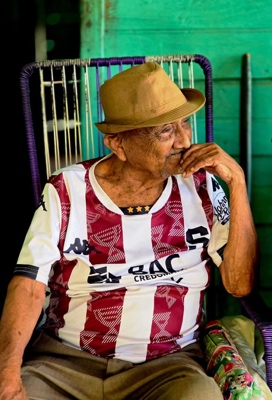
Costa Rica is globally recognized for its “Blue Zones,” regions with exceptional longevity and lower mortality rates. As part of the delegation, we visited the Nicoya Peninsula on Costa Rica’s west coast, where we met several centenarians in their homes. Listening to their life stories and observing their daily routines offered invaluable insight into how environment, diet, social connection, and purpose contribute to healthy aging.
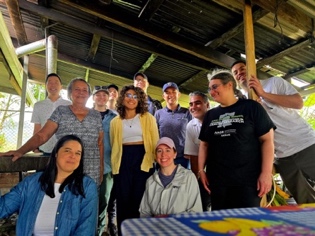
From Nicoya, we traveled northwest to the Upala, a high-longevity region nestled in the jungle. There, we visited a research and education center closely partnered with UCR, as well as a women-led cooperative producing butterfly pupae for export, an inspiring example of science, sustainability, and economic empowerment intersecting at the community level. Our stay at La Anita Rainforest Ranch further underscored the deep connection between environment, biodiversity, and health.
The following day, we met additional centenarians and visited a community center for older adults, where shared meals and daily social interaction form the backbone of community life, powerful reminders that social cohesion is a cornerstone of longevity.
Science, Microbes, and Mutual Exchange
Throughout the trip, we were accompanied by Dr. Adrián Pinto Tomás, a microbiologist at UCR and our host, along with Dr. Carlos Faerron Guzman, Associate Professor at the University of Maryland Baltimore’s School of Graduate Studies, resident of Costa Rica, and liaison for the Alicia and Yaya Foundation. Dr. Pinto’s research on leaf-cutting ants, remarkable organisms that cultivate fungi and bacteria for survival, provided a fascinating parallel to human microbiome research. These ants, which we observed in the laboratory and in the wild, maintain complex microbial ecosystems that produce antimicrobial compounds that Adrian studies, offer novel insights into microbial cooperation, resilience, and defense, and, of course, represent a potential source of novel antimicrobial drugs. His work has led to the development of a novel atypical antifungal, selvamicin1.
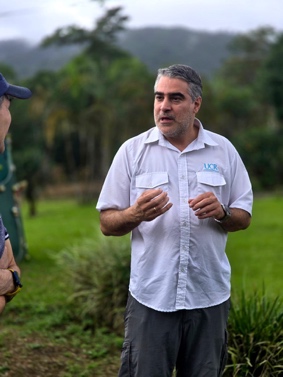
The delegation concluded in San José with a visit to UCR, where I delivered a lecture titled “Translating Our Understanding of the Host–Cervicovaginal Microbiome Interface to Improve Women’s Health.” The talk highlighted how the human microbiome, a major determinant of lifelong health, shapes women’s health across the lifespan and likely plays a critical role in healthy aging and longevity. Dr. Elana Fertig, Director of the Institute for Genome Sciences at UMSOM, followed with a presentation titled “Tumor Immune Dynamics for Predictive Cancer Immunotherapy,” an area being explored to establish collaborative research between UCR and UMSOM scientists. The group then toured UCR’s innovative pathology laboratory, an integrated facility designed to bring genomics-based medicine directly to patients through close alignment of clinical care and research. The afternoon was dedicated to thematic working group meetings focused on microbiome science, genomics, and cancer, providing participants the opportunity to share their research and identify potential collaborative research and educational initiatives.
Training the Next Generation: Hands-On Microbiome and Single-Cell Workshops
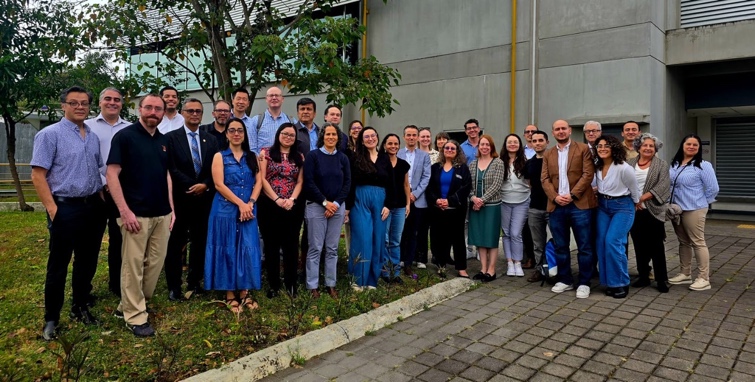
A central goal of the visit was not only to exchange ideas but also to build local capacity through hands-on training. As part of the delegation, Dr. Michelle Giglio, Associate Professor of Medicine at UMSOM, and Dr. Joe Receveur, education coordinator at IGS, led two intensive, one-day workshops designed for University of Costa Rica students and faculty.
The first workshop provided an introduction to microbiome data analysis, covering foundational concepts, analytical strategies, and practical considerations for working with microbial community data. The second focused on single-cell transcriptomic data analysis, introducing participants to experimental design, data structure, and modern computational approaches for studying cellular heterogeneity.
The single-cell workshop was also supported by Dr. Emily Lasse Opshal, a postdoctoral fellow in the laboratory of Dr. Elana Fertig, Director of IGS. Emily’s expertise helped guide participants through real-world analytical workflows. Together, these sessions fostered lively discussion and engagement, reflecting strong interest among UCR trainees and faculty in applying advanced genomic and computational tools to studies of aging, microbiomes, cancer, and human health.
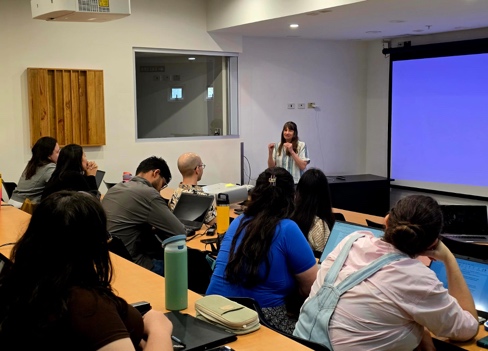
These workshops exemplified the spirit of reciprocal collaboration that underpins this emerging partnership, pairing scientific discovery with education and skills development to ensure long-term impact.
Looking Ahead: A Lasting Collaboration
The visit sparked in-depth discussions around joint research projects examining the role of the human microbiome in longevity, as well as the largely unexplored area of women’s health in very old age. These conversations are already evolving into concrete plans for collaboration, including exchange programs in which Costa Rican students and scientists will visit CAMRI, and CAMRI investigators will travel to UCR to lead workshops in microbiome science, genomics, and data analysis.
None of this would have been possible without the vision and support of the Alicia and Yaya Foundation. By investing in education, scientific exchange, and international collaboration, the Foundation is helping catalyze research that connects biology, culture, and community, advancing our understanding of aging while training the next generation of scientists in Costa Rica and beyond.
Reference
1. E.B. Van Arnam, A.C. Ruzzini, C.S. Sit, H. Horn, A.A. Pinto-Tomás, C.R. Currie, & J. Clardy. Selvamicin, an atypical antifungal polyene from two alternative genomic contexts, Proc. Natl. Acad. Sci. U.S.A. 113 (46) 12940-12945. https://doi.org/10.1073/pnas.1613285113 (2016).